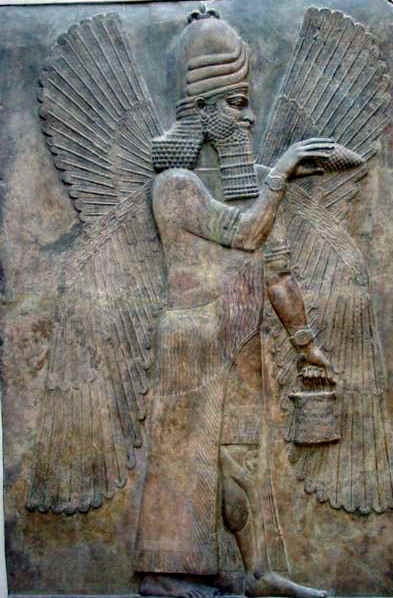
Friday, July 2, 2010

The Cosmogony of Our Solar System - Condensed from the 12th Planet


In the beginning
Elohim created the heaven and the earth
And the earth was without form and void
And darkness was upon the face of Tehom,
and the wind of the Lord over its waters.


The Bible is clear when it comes to the description of the moment of Beginning as far as the Earth is concerned. However, it only picks the Mesopotamian story of the cosmogonical creation of the universe from the point of the separation of the Earth and the Shama’im, the Hammered Bracelet which resulted from the break up of Tiamat.


It took great scientific minds during the Mesolithic Age more than 5,000 years ago to imagine the primeval phase of our Solar System; how the Earth came into being not through the Big Bang, but during the events of the Celestial Battle.

It was then, at that single instance how Time began on Earth when the watery planet Tiamat was split into half by a rogue planet the Sumerians referred to as Marduk/Nibiru. The separated half of Tiamat became to be known as the Asteroid Belt (Heaven- the Hammered Bracelet) while the remaining part spun towards a new orbit as it heals itself to form our home and what is now called the planet Earth. According to the Enuma Elish, the stability of the planets in our Solar System is attributed to the arrival of the planet Marduk/Nibiru- a planet that came from the deep space at least four times the size of our planet.


When in heights Heaven had not been named,
And below, Earth had not been called
Naught, but primordial Apsu, their begetter,
Mummu, and Tiamat- she who bore them all,
Their waters were mingled together

No reed had yet formed, no marshland appeared.
None of the gods had yet been brought into being
None bore a name, their destinies were undetermined;
Then it was that gods where formed in their midst.
Gor Lahamu and god Lahamu were brought forth;
By name they were called.


Before the beginning of time, in the immensity of the infinite universe – when the planets where yet to be named and their orbits have yet to be fixed; only three celestial bodies exist in our own Solar System, the Sun (Apsu), Mercury (Mummu), and a watery planet called Tiamat.
The Sun (Apsu) existed from the very beginning. Closest to the Sun was Mercury (Mummu) - its’ emissary, rapidly turning around its giant master. A little farther away was Tiamat (a watery planet). The space between Tiamat and the Sun was not empty for their “primordial waters” mingled together creating the life-giving elements for the new two planets Mars (Lahmu) and Venus (Lahamu).


Before they had grown in age
And in stature to an appointed size
God Anshar and god Kishar were formed, Surpassing them (in size).
As lengthened the days and multiplied the years,
God Anu (Uranus) became their son – of his ancestors a rival.
Then Anshars’s first born, Anu,
As his equal and in his image begot Nudimmud (Neptune).


Mars and Venus grew only to a limited extent. But even before their growth was complete, another pair of planets was formed. These two majestic planets as evidenced by their names- Saturn (Anshar- “prince of heaven”), Jupiter (Kishar-“foremost of the firm lands”).overtook the growth of the first pair exceeding them in stature. The process of the celestial formations continued and a third pair of planets came to being. First came Uranus (Anu), smaller than Saturn and Jupiter, but larger than its predecessors. Uranus in time begot a twin planet equal in its size and image –Neptune, was referred to by the Babylonians as Nudimmud, and Pluto as Gaga. The small body Pluto functioned like the planet Mercury which the Sumerians placed in their celestial map not beyond Neptune, but next to Saturn, acting as its satellite.


The divine brothers banded together;
They disturbed Tiamat as they surged back and forth. They were troubling the “belly” of Tiamat By their antics in the dwellings of heaven.
Apsu could not lessen their clamour; Tiamat was speechless at their ways.
Their doings were loathsome….
Troublesome was their ways


With the end of the grandiose drama of the birth of the planets, each having unstable status, was drawn towards each other and converging on to Tiamat’s belly (orbit) endangering the primordial bodies. The new planets’ surging “back and forth” was an obvious reference to their erratic orbiting. The planet’s behaviour also threatened the Sun.

The epic goes on to portray the Sun and its “emissary” Mercury huddling together as if devising a plan to rid themselves of the loathsome spheres. The group became astounded upon overhearing the plan of the two “gods” (The Sun and Mercury). The only planet that seemed projected to destroy the Sun (Apsu) and its companion Mercury (Mummu) at this time was Neptune (Nudimmud) which during its pass over to the Sun radiating huge amounts of electro-magnetic energy which produced a “calming effect” to the Sun stopping it from forming additional celestial matters. Even the Sun’s faithful ally Mercury appeared vulnerable during this stage. Any new additional planets to our Solar System at this time could only have come from the far reaches of space. Nobody knows how long was the celestial peace was but for sure there was a lull in the transformations happening in our solar system.

In the Chamber of Fates, the Place of Destinies,
A God was engendered, most able and wisest of the gods;
In the heart of the deep Marduk/Nibiru created.


Four billion years ago, a new Celestial “god” called Marduk (Nibiru), was borne from deep space. It maintained a solar orbit equivalent to 3,600 earth years moving at a clockwise direction. As the young planet followed its circular path it was attracted to our Solar System by its outermost planet – Neptune. The new planet was a sight to behold.

Alluring was his figure, sparkling the lift of his eyes; Lordly was his gait, commanding as of olden times. Greatly was he exalted amongst other gods, exceeding throughout…
He was loftiest of the gods, surprising was his height;
His members were enormous, he was exceedingly tall.


Emerging from outside the orbits of our Solar System the planet Nibiru was still in its infancy belching fire and emitting radiations. As it moved close by other planets


As Marduk/Nibiru (Nibiru) approached the young planets “...they heaped upon him their awesome flashes”, and he shone brightly, “clothed with the halo of ten gods.” This demonstrates the electrical reactions and other emissions of the planets during Marduk/Nibiru’s course through our Solar System. The “ten gods” mentioned confirms the correct decipherment of the epic. According to the early Sumerians, there are ten celestial bodies that awaited Marduk/Nibiru on its channel- the Sun, and only nine other planets.


Marduk/Nibiru sped pass by the planet Neptune (Nudimmud/Ea) that dragged him to our Solar System. Its gravitational pull must have been so immense it caused Nibiru who was at its primitive stage to bulge a second “head.” No part was torn-off at this point but as soon as “winged planet” reached the area of Uranus (Anu), chunks of matter tore-off from producing four satellites for him self while at the same time tilting the orbit of Uranus.


“Anu brought forth and fashioned the four sides, consigned their power to the leader of the host”, and “swirling as a whirlwind.”
The chunks called “winds” as it swirled around the planet Marduk/Nibiru that begot them. The way the rogue planet moved towards our Solar System indicates that it was coming not in the system’s orbital (counter clockwise) but in a reverse mode. Traveling further inwards the two gigantic planets Saturn (Anshar) and Jupiter’s (Kishar) magnetic force grabs Marduk/Nibiru hurling it towards the center of the solar system towards the path of the watery planet Tiamat.

The approach of the crossing planet perturbed the inner planets Tiamat, Mars, Venus, and Mercury. “He produced streams, disturbed Tiamat; the gods were not at rest, carried as in a storm.” The lines of the ancient text were partially damaged and described the approaching planet “diluted their vitals…pinched their eyes.” Tiamat was “paced about distraught” pointing out that her orbit is being affected.
The arrival of the large planet began to tear away parts of Tiamat. The epic went on to describe its eleven “monsters” – large pieces of satellite “growling, raging” as it emerged and “marched at the side of Tiamat.” Standing bravely she positioned herself to do battle with the onrushing Marduk/Nibiru. Tiamat “crowned them with halos,” making them the appearance of “gods” (planets).

She exalted Kingu,
In their midst, she made him great…
The high command of the battle
She entrusted into his hand...

“…she has set-up an Assembly and is furious with rage... she has added matchless weapons has borne monster gods…
with eleven of this kind she has brought forth;
from among the gods who formed her Assembly,
She has elevated Kingu, her first-born, made him chief…
she has given him a Tablet of Destinies, fastened it on its breast.”


Tiamat’s first-born satellite was named Kingu - exposed to the brawling gravitational pulls between the two warring planets, Marduk/Nibiru’s gravitation sucked off Kingu’s atmosphere and its imminent solar orbit was shifted towards circling Tiamat’s orbit instead of the sun. Tiamat’s newly sprouted moon’s traveling from their counter-clockwise orbits where dragged by Marduk/Nibiru’s gravitational pull and followed the wayward planet encircling the invading planet on a clockwise direction from then on.

Turning to Ea (Neptune), Anshar (Saturn) asked him whether he could go to slay Kingu. The reply is lost due to a break in the tablets; but apparently Ea did not satisfy Anshar, for the continuing narrative has Anshar turning to Anu (Uranus) to find out whether he would…“go stand up to Tiamat.” But Anu “was unable to face her and turned back.” [Sitchin, Z. - The 12th Planet, p.221]

The heavens were agitated as a result of the raging battle between the planet Marduk//Nibiru and Tiamat, but no one amongst the outer planets seemed able to follow the path the winged planet had taken.

Passing Neptune and Uranus, the fighter Marduk/Nibiru approaches the ringed planet with all its might. In the process, it pulled Pluto (Gaga) - the biggest satellite of Saturn and loosened it from its present course. The god Anshar hoping to appease the conquering ‘god” proclaimed “He who is potent shall be our Avenger: He who is keen in battle: Marduk, the Hero! Arriving just barely at Saturn’s rings “he kissed the lips of Anshar.” Marduk Answers:

“If I indeed, as your Avenger
Am to vanquish Tiamat, save your lives- Convene an Assembly to proclaim my Destiny supreme!”


Marduk/Nibiru seemed to have established itself as the supreme amongst the “celestial gods” (planets).

Anshar opened his mouth, to Gaga, his Counsellor, a word he addressed,” Be on the way, Gaga take the stand before the gods, and that which I will tell thee. Repeat thou unto them.” [Sitchin, Z. - The 12th Planet, p.221]

Pluto (Gaga), true to its role of being the emissary of the god Saturn (Anshar) orbited its path and advising the other “gods” to fix their courses. These delighted the other “gods” (planets) knowing there is someone else who will straighten out things with Tiamat (watery planet) for them. “Marduk is king!” they all proclaimed. “Go and cut-off the life of Tiamat!”


With all the planets now acquiring their fixed orbital paths and out of its way, the rogue planet appears unstoppable heading towards a collision with the watery planet Tiamat who waits for battle.

Like a true warrior, Marduk/Nibiru is armed to the teeth with weapons. Shining in his armour like a “blazing flame”, “he constructed a bow…attached thereto an arrow… in front of him he set the lightning” and “he then made a net to enfold Tiamat therein.”

Such descriptions depict electrical phenomena when two celestial bodies converge to a certain point. But Marduk/Nibiru’s greatest weapons were his satellites, the “four winds” which the “god” Uranus (Anu) provided him: South Wind, North Wind, West Wind and East Wind.


As Marduk now passed by the giant planets Saturn and Jupiter, the red planet was vulnerable to its tremendous gravitational pulls. In order to escape this Marduk “brought forth” three more satellites – Evil Wind, Whirlwind, and Matchless Wind using them as a “storm chariot” towards the battle site. The adversaries were ready for battle.

The Lord went forth, followed his course; Towards the raging Tiamat he set his face…The Lord approached to scan the inner side of Tiamat – The scheme of Kingu, her consort to perceive. As the planets drew closer to each other, Marduk’s course became erratic: As he looks on, his course becomes upset,
His direction is distracted, his doings are confused. Marduk’s satellites also began to stir off course:

When the gods, his helper
Who were marching at his side,
Saw the valiant Kingu, blurred became their vision.


In spite of the frenzy on the side of invaders the die was cast, the two gods were set on a collision course.

“Tiamat emitted a roar”…”the Lord raised the flooding, his mighty weapon.”

The closer Marduk gets, the “fury” of Tiamat grew.

“The roots of her legs shook back and forth” as she started to cast “spells” against Marduk who kept coming at her.

Tiamat and Marduk, the wisest of the gods,
Advanced against one another;
They pressed on to single combat,
They approached for battle.


The epic went on to describe the battle between the two gods (planets) that leads eventually to the creation of the planet Earth.


The Lord spread out its net to enfold her;
The Evil Wind, the rearmost, he unleashed at her face.
As she opened her mouth, Tiamat, to devour him-
He drove in the Evil Wind so that she close not her lips.
The fierce storm Winds then charged her belly;
It cut through her insides, tore into her womb.
Having thus subdued her, her life-breath he extinguished.


The two planets did not collide for it was the satellite of Marduk that hit Tiamat’s belly. Seeing a wide cleavage exposed on Tiamat’s belly, Marduk shot an “arrow” of “divine lightning” – an immense bolt of electricity from the energy-charged Marduk -the planet “filled with brilliance.” The shot “extinguished her life-breadth” for it defused Tiamat’s own electric and magnetic fields.

Marduk’s initial passage to Tiamat’s domain left her lifeless, but her final state is yet to be determined by the next future pass over by Marduk. Unlike Kingu, the fate of the ten smaller satellites of Tiamat was concluded at once.

After he had slain Tiamat, the leader,
Her band was shattered, her host broken up.
The gods, her helpers who marched at her side,
Trembling with fear,
Turned their backs about so as to save and preserve their lives.


One amazing observable fact in the universe today is the comets. Those icy mud balls are often referred to as the rebellious members of the Solar System for they appear not to obey the laws that govern the motions of the planets. The orbits of the planets (except Pluto) move around the sun in a circular motion and in the same plane. The comets on the other hand follow an oblique orbit and may lie in diverse planes. While all the known planets of our Solar System move in a counter clockwise direction, comets travel in the reverse direction.

Mr. Sitchin offers us a theory what might have created and caused the Comets to behave this way: The planet Marduk sweeping our Solar System during its initial passage was moving in an opposite direction traversing his own orbital plane smashed the smaller satellites of Tiamat into smaller comets affecting them by his “net” (gravitational pull).

Thrown into the net, they found themselves ensnared…
The whole band of demons that had marched on her side
He cast into fetters, their hands he bound…
Tightly encircled, they could not escape.


After the battle was over Marduk took away Kingu’s orbit. From that time on the planet Marduk is always bound to return to the former scene of celestial battle


The Creation of “Heaven” and Earth

It is at this point of the Epic of Creation that the biblical tale of Genesis draws its stories. Completing its 3,600 year orbital passage around the sun the planet Marduk returns to face Tiamat whom he subdued.

The Lord paused to view her lifeless body.
To divide the monster he artfully planned.
Then as a mussel, he split her into two parts


Marduk charged towards the subdued planet. He himself struck Tiamat tearing it into two, severing its “skull” (upper part). Afterwards, another of Marduk’s satellite (North Wind) crushed to the detached part, and plunged it into a new orbit where no planet has orbited before -to form the present day Earth.

The Lord trod upon Tiamat’s hinder part;
With His weapon the connected skull he cut lose;
He severed the channels of her blood;
And caused the North Wind to bear it
To places that have been unknown.


The remaining half of Tiamat floating in space suffered another fate when it took a direct hit from the passage of Marduk and smashed it into pieces.

The (other) half of her he set up as a screen for the skies”
Locking them together, as watchmen he stationed them…
He bent Tiamat’s tail to form the Great Band as a bracelet.


Stretched out in the firmament are the remains of Tiamat like a hammered “bracelet” acting as a screen between the inner planets and the outer planets. This is how the Asteroid Belt had been formed.

Biblical academics now do recognize that the Hebrew word Tehom (watery deep) originated from the word Tiamat. Tehom-Raba means “great Tiamat.” The biblical perceptive of primordial events is based on Sumerian cosmologic epics. The first among the parallels are the opening verses of Genesis describing how the Wind of the Lord hovered over the waters of Tehom, and how the lightning of the Lord (Marduk) lit the darkness of space as it hit and split Tiamat, creating the Earth and the Rakia (hammered bracelet) or hat we call Heaven.


When the North Wind of Marduk brought the new Earth to its new celestial home, Earth obtained a new orbital path around the sun and received its axial spin. Scientists believe that when the Earth was young it was a hot ball of exploding volcanoes filling the skies with clouds. As the temperature cooled off, the vapour from the air turned into water, dividing the face of the earth into land and water and forming the atmosphere and the foundations of the continents.

The enigmas of our Solar System, its great oceanic deeps, the devastation of the moon, the orbit of the comets, the mystery of the phenomena of Pluto – all is answered by the great Mesopotamian epic.

Having thus”constructed the stations” for the planets, the planet Nibiru “crossed the heavens and surveyed” the new solar system. It was now made up of twelve celestial bodies, with twelve great gods as their counterparts.


Sources: The 12th Planet, When Time Began - By: Zecharia Sitchin

Wednesday, August 19, 2009

The Kissing of the Hands- A Gift from the Ancient Spice Route

The World beyond the Two Worlds

The Philippines is a country endowed with rich history. Its custom and traditions reflect ancient established practices that transform the Filipino society into what is now a vibrant world-renowned community. Much akin to their Asian neighbours Filipinos possess an extraordinary reverence for their elders which is an envy of the west. This powerful cohesive social force remains constantly impacted by historic sociological factors. The responsibility to preserve these inherited gifts rests upon its people who must pass their culture to future generations. One shining trait Filipinos are known for though is the “kissing of the hand” (pag-halik ng kamay). How it became an accepted social norm is still everybody’s guess. Is it something indigenous to them, or is it a concoction of centuries of acculturation?

Long before the advent of the arrival of our European colonialists, the Philippine shores was already bustling of commerce with our Malayan neighbours (including the Japanese, Chinese, and the Arabs). It is interesting to note that in 1521, Magellan’s Malay guide Enrique (first truly to have circumnavigated the world) whom he met in Moluccas prior to his voyage, was described as someone who spoke fluently the dialect of the Cebuanos. The only question is, did the locals used the Indonesian language as their lingua franca, or was Enrique really a seasoned trader from Cebu who frequented the Mollucas?

Spicing Up the Whole World

The Maluku Islands (also known as the Moluccas) is an Indonesian archipelago in the maritime islands of the Southeast Asian region. The Chinese and the Europeans refer to it as the Spice Islands- five islands of volcanic origin (Ternate, Tidore, Moti, Makian, and Bacan). They are found off of the west coast of the island of Halmahera, in the Indonesian archipelago. These islands have been the hub of traders from as early as 300 BCE or even earlier. Medieval travellers including Marco Polo mentioned nothing about the Moluccas, but one of the earliest and most reliable reference to the Spice Islands came from the Arab geographer Ibn Khurdadhbeh (ca.850). Until the mid 19th century, Nutmeg (Myristica fragrans) has been endemic to the Banda Islands of the Moluccas. Clove (Syzygium aromaticum) is native to Indonesia and India. Both were highly valued food preservatives.

In the 7th century CE, the Srivijayan empire influenced much of the Malay world. Dominating the Malacca and Sunda straits, the Srivijayan Empire managed both the spice route traffic and local trade, charging a toll on passing ships. Serving as an entrepôt for Chinese, Malay, and Indian markets, the port of Palembang was accessible from the coast by way of a river accumulating great wealth. Envoys travelled to and from China frequently. Around 1293 CE, the last of the major empires of the Malay Archipelago defeated the Srivijayan empire reigning over the rest of the maritime Southeast Asia . Geographical and economic constraints suggest that the empire outside its seat of power from Java where connected mainly bu trade.

Buddhism and Hinduism managed its way to Indonesia when trading activity began in the early of first century on the Silk Road. The Silk Road is an extensive interconnected network of trade routes that started 3,000 years ago linking China across the Asian continent connecting East, South, and Western Asia with the Mediterranean world, as well as North and Northeast Africa and Europe. It bonded powerful civilizations such as Rome and China. It brings to mind pictures of lush desert oases and far-flung crossroad settlements crowded with merchants, spiritual pilgrims, and adventurous travelers from many regions, the Silk Road has become in our time a metaphor for cultural exchange among people of diverse societies, distant places, and different religions.

The continuous trade contacts between the Moluccas and the Muslim merchants from Arabia and elsewhere in Asia brought along a new major religion to Southeast Asia. By way of Sumatra around 651 CE, Uthman ibn Affan, (C. 579-656) sent a group of Islamic Missionaries to China converting some Indonesians on their way. Around 1380, Karim ul' Makhdum, reached the Sulu Archipelago and Mindanao converting the animist population into Islam. Muslim influences rapidly ascended northward up the archipelago, reaching as far as the current capital of Manila on the island of Luzon. They did not only bring their religion with them but also saw to it that political systems were established. The first official Sultan of Sulu was an Arab from Sumatra named Abu Bakr, crowning himself around 1450. Like many other Arab rulers, he established his dynasty's legitimacy by claiming to be a direct descendent of Muhammad. Hence, the arrival of Islam to the orient contributed to the rapid decline of the Hindu and Buddhist influences in the region.When the Spaniards arrived in the Philippines two hundred years later they were dismayed to see Islamic influence being already prevalent around the country.

Cultural Amalagamation


The Silk Road to China and the spices of Asia did not only bring with them trade but also cultural and reliqious values. Layers of cultural incorporation antecede the arrival of Islam in Indonesia. Hindu-Buddhist traditons is still evident today when a Javanese military officer requires their prisoner to touch his forehead to his warden’s knee. The Indonesian acknowledgement of a superior or a guru is demonstrated by kissing his hand and pressing it to one’s heart or forehead is also a Hindu-Buddhist underlay of Islam. Arab salutation also requires a person of an inferior status to take one’s hand and kiss touchjng it on their forehead. A related practice is also alive in the Turkish culture that they lay claim to own the custom of Hand-kissing. In Europe, it was started by the Spanish Royal Court in the 17th and 18th century, and later on adapted by the rest of the continent in the 18th century becoming a common European upper-class tradition. In Western Christianity, the kissing of the hands began when Roman Catholics, Anglican, Lutheran, and Eastern Catholic bishops since 430 CE started wearing rings regarded as emblematic of the mystical betrothal of the bishop to his church. Custom indicate that layman or clerics with inferior grade when presented before a bishop is expected to kiss his episcopal ring (baciamano in Italian). There is common misconception that performing the act of kissing the hand brings with it full or partial release from sin(indulgence). The pagans practice idol worshipping by kissing its hand when the idol was conveniently low enough. If not, the devotees kissed their own hands and waved them to the image. (Judges 2:18).

If the kissing of the hands is frowned upon in Islam since it is a form of Sajdah (prayer position) reserved only for the One and true God -where did it truly start? Does it mean the practice pre-dates Islam and Christian religion and denotes primordial pagan way? Conversely, is the Filipino way of kissing the hand an off-shoot of the old Turkish tradition when the Arabs engaged in the Silk Road trade via the Srivijayan Empire, or did our forefathers accede and emulated the church’s way of reverence for authority?

Mesopotamia is known to be the cradle of civilization. It is a land corresponding to modern-day Iraq, northeastern Syria, southeastern Turkey and southwestern Iran. The form and content of Babylonian worship are entirely borrowed from the Sumerians. This is particularly true of the principles of formal worship or the gestures employed in religious devotion. As to the contents of the words spoken during their public liturgies of the Babylonians is no doubt Sumerian. Prayers of private devotion and all the intricate rituals of the magic cults are Semitic Babylonian in origin. The Assyrian religions traces their way of worship to their gods as Babylonian but tends to preserve more the Semitic way of private devotions. Also, the Assyrian liturgical offices were borrowed entirely from the old canonical Sumerian breviaries.

It is my opinion that the practicing of the kissing of the hands traces its roots from the oldest civilization known to mankind and may have metamorphosed to its present form . Very early Sumerian seals belonging to the pre-historic period (3,000 BC) reveal three traditional poses assumed by a Sumerian layman in private devotion, or when he stands before a seated deity to say his prayers.

1. The seal depicts a processional scene, where his protecting god (or the High Priest) leads the layman by the hand to a seated deity. During the pre-Sargonic period, the posture of the adorant’s hand was not yet fixed. There are times when the worshipper’s hands are free and would carry a lamb or a kid to offer. On one seal, the arm is folded across the waist. Quite amazingly, these traits are characteristic of both Sumerian and Egyptian religions suggesting a much more pre-historic contact between the two lands.
2. The worshipper stands with one hand raised parallel to the breast, palm inwards and fingers touching the lips; the other arm is folded across the waist. This is the very ancient salutation by throwing a kiss and is the most common gesture of early Sumerians and Babylonians, and down to the Neo-Babylonian period.
3. The third seal depicts a worshipper standing with both hands folded at the waist. The right hand is clasped by the left hand in extraordinary manner so that the right hand thumb rests on the body while the rest of the fingers lie horizontal to the body.

Before and during the Sargonic period the Semites lived in closed contact with the Sumerians and adopted the Sumerian principles of gestures. A seal dedicated to Naram-Sin (5th king of Sargonic period) represented a worshipper “lifting a hand” to employ a kiss hand “to pray” at the deity. In the period of Gudea and Ur Dynasty (2650-2358 BC), the processional rite was still being practiced, but the disengaged arm is always held in the attitude of praising the deities. During the period of Isin, Larsa, and the Babylonian 1st Dynasty (2356-1926 BC) archaeological evidences suggests that the processional rites with the raised arm gesture was discontinued for the independent attitude. The suppliant now stand with the right hand raised and touching the lips while the left arms remains folded on the waist.

Another best find from archaeology is the stele of the ancient Law Code of Hamurrabi.The Kissing of the Hand was also part of development taken out from the ancient Law Code of Hamurabbi (1760 BCE). Stelae were displayed in temples around during the Babylonian Empire. Of these only one example survives, inscribed on a seven foot, four inch tall basalt stone slab or stele, preserved in the Louvre.

The stele containing the Code of Hammurabi was discovered in 1901 by the Egyptologist Gustav Jéquier, a member of the expedition headed by Jacques de Morgan. The stele was discovered in what is now Khūzestān, Iran (ancient Susa, Elam).

At the top of the stele is a bas-relief image of a Babylonian god (either Marduk or Shamash), with the king of Babylon presenting himself to the god, with his right hand raised to his mouth as a mark of respect.


End of the Silk Road

There is a Turkish saying, “Alnında yazılıysa olur.” - If it is written on your forehead, it will happen. (on your forehead) (if written) (happen). Whereas, the forehead symbolizes one’s destiny, the head represents the self as a whole.
The practice of the kissing of the hands is a patriarchal tradition. Societies who have accepted this as a model allows a fatherly figure to have influence over the younger family members. By allowing a person of authority to touch our foreheads is a sign that we submit our own virtues and entrust ourselves to the guidance and blessings of who were there before us.

From Istanbul to Xian, from San Luca, Spain to Cebu, the journey of the kissing of the hands has gone thousands of miles and ends up in the Philippines. The quest for the trade routes to the orient yielded not only silk and spices, but golden traditions that unite families, and gave rise to empires and civilizations.


Sources: Indonesian Destinies by: Theodore Friend, Instant Indonesia: Religion of Indonesia, Between East and West by: R. Donkin, Syria and the Holy Land, Their Scenery and People, by: Walter Keating Kelly, International Perspectives on Family Violence and Abuse: A Cognitive Ecological Approach: by Kathleen Malley-Morrison, Marius the Epicurean, by: Walter Pater: Chap. V. Published 1885), L. Paine - Ships of Discovery P. 146, Caeremoniale episcoporum (Book II, viii, nn. 10-11)

Friday, July 24, 2009

Immortalizing Canlubang

Calamba is a city in the Laguna province situated some 54 kilometers south of Manila along the Laguna de Bay. Over the years this birthplace of our national heroe has turned into an important industrial hub and tourist destination. Canlubang is the biggest baranggay in Calamba. The name Canlubang descended from the tagalog term Kanlungan ng mga tulisan (bandit's haven). Its thick foliage must have been a good bastion for the marauding outlaws in the colonial times.

When the old mill's production stopped years ago nature started to reclaim what was rightfully hers. Grass meadows now invade open lands of once sugar cane fields. Rotting foundations strangled by vines stand defiantly against the ravages of a forlorn time. Pot-holed muddy roads snake through the neighbourhoods as a few brave and loyal souls struggle to reach their dilapidated homes hoping to survive the onslaught of an oncoming typhoon. Bulldozers roar like thunder devouring ancient houses along its path givimg way to the development of first class subdivisions that will cater to a new breed of upper class society.

They say Atlantis was a legendary city that submerged overnight 9,000 years ago. It sank as a result of a great volcanic activity. Apparently, it was the cradle of all civilizations, but no historical records pertain to its existence except in Homer's poem Odyssey. Canlubang's history on the other hand transpired only a little less than a century ago but its bountiful history seems to have been tossed to oblivion. The neck of the wood's heyday was seen after the last war when the sugar economy of the Philippines reached its pinnacle. A classic hacienda/enconmienda system was in effect to manage the self-sufficient private community of 45,000 who use to enjoy world-class perks of free hospitalization, dental, water, electricity, Christmas give-a-ways, housing and repairs including subsidized groceries and a public market. Added to the their long list of perks, this paradise boasted of free public pools, a drive-in movie, tennis courts, a golf course, a pelota court, parks and playgrounds on every sitio, a labour hall, a convent and a seminary, a pavillon, bowling alleys, a catholic church, a plaza, free private schooling in the primary and seconday levels, a baseball stadium (considered to be the oldest in the Philippines) that was home to its popular team- the Canlubang Sugar Barons.

Canlubang's demise was painful, and a gradual one. There are many factors for the death of the sugar industry in the Philippines. To name a few, one is the development in the 60's of High Fructose Corn Syrup in the United States that resulted in the tragic reductions in the sugar cane quotas in the US. In order to keep the sugar industry afloat, the Philippines was forced to sell its sugar to the world market dumped by subsidized and cheaper sugar from the European Community. Even international sugar agreements failed to cushion the massive fluctuations in the world prices over the past decades. But if you really want to dig further down to the root cause of all these problems you have to remember your lessons in history.

Noticed how former colonies in the world are mostly poor and politically unstable? Take for example past Spanish territories, most are poor not because they practice Roman Catholicism, but because a culture of rapaciousness is perpetuated. Six hundred years ago, colonial powers implemented land tenure arrangements. Peasants were divested lands, created plantation economies, maimed local wealth that relied solely on the exportation of raw materials, and destroyed industries that could have challenged foreign industries. Ravenousness is propagated in the midst of political freedom through unfair trade practices on tariffs that can be four times higher on former colonies than their former colonizers. International banking lenders loan huge amounts to finance large projects that still benefits foreign companies engaged in local resource extraction through the sustenance of foreign government powers.

Canlubang is but one of the casualties in this culture of greed. Thanks to an extremely biased world, we are poor because they are rich. The Canlubang of today is now a picture of destruction and progression. Its agonizing metamorphosis is a lost to many, and a gain for some.


Sons and daughters of Canlubang, her story begs to be told. Pause for a while and close your eyes. Try to recall the loud horn of the mill as armies of workers march to and from work while the three giant black chimney stack belches out a steam of smoke. Never, never forget for once, the sugar mill that brought sweetness to coffee cups and candie bars of the new world.

Note: I find it odd why a single article can not be found in print or electronic (Internet ) that gives credence to the grandeur of this once vibrant community. Be proud of your past. Show to the world how it was to live in Canlubang's glorious past by posting old and new photographs in this site. Blog articles are also welcome to be submitted for posting at http://www.freewebs.com/sugarmills

Friday, May 1, 2009

Reliving a Grandparent's Love


It is 6 pm on an evening in the summer of 1971. The velvety sun is almost ready to set on the horizon. Men, beast, and machines ground to a halt. The church bells ring in cadence like a poignant poem as the recitation of the Oracion emanate from her red belfry tower. Canlubang once again seems to be suspended in time except for the three iconic black chimney towers of the Azucarera which continue to waft-up a cloud of smoke as the melodious birda chirp while perched from the giant caballero tree(fire tree). Inside an ancient home still bearing the scars of the previous war, an altar raised to the wall sits the glass-encased image of the Cristo Rei in between Maria and San Jose. “Ave Maria Purisima. Sin pecado consebida” ("Hail most pure Mary, conceived without sin") a common exclamation is uttered as my grandmother leads the Santo Rosario(Holy Rosary) with her whole family. With our tiny palms clasped, the litany of prayers in Spanish is recited in unison by the grandchildren some of whom would remember by heart even until this very day. As the prayer ends, the young would pay their respect to our elders by uttering “mano po”,and touching the back of their palms held by our tiny hands to our foreheads to accept their blessings. The tradition is culminated with the blowing of the candles by the child in-charge who set the prayer table. Candles that end up clean after each prayer would mean a soul is under the grace of God. Too much candle-dropping on the candelabra would mean it is time to see the priest and receive the sacrament of Confession.

Lola Feling – Healer and Grandmother

Long before there were Chiropractors and Physical Therapists, my lola was known to be an esoteric mang-hihilot(Chiropractor). She attributed her gift of healing from a dream when she was young. In her vision, the Niño Jesus was in pain and in need of help. Not knowing what to do, the little boy imparted to her the knowledge of dealing with bodily sicknesses through manipulations and chiropractic massages. She applies coconut oil and strips of medicinal herbs to diagnose the area of strain and apply different massaging techniques. Grandmother also performed a diagnostic ritual to determine the cause of an illness called *Tawas (alum). This ritual is performed with a variety of other material such as a holy scapular, banana leaves, coconut shell, and some incense. One notable case she had was about this man who stayed bed-ridden at the hospital for so long until the doctors finally gave up on him. Thinking there was nothing to lose in using an unconventional way of therapy, the wife requested for grandma’s help. All what lola did was to ask for the patient’s shirt and performed the ritual of Tawas with it. The following day, that man was at her front door looking so well as if nothing really ever happened.

When my grandma was not battling the supernatural, she fulfills the role of being a mother who takes care of her whole family. On days when she arrives home from the palengke(market), grandma never fails to bring in our favourite bibingka (rice cake) as a pasalubong(take home present) or those native cocoa balls she kept in a jar for dessert. I also have fond memories of seeing her in the kitchen cooking those hot chilly recipes. According to her, it was a test of having a Bicolano(Bicol province) blood in us if we can endure such hot palatable dishes. Sitting on a rocking chair by the window on hot summer afternoons fanning with an abaniko (weaved native fan), we are all ears to her funny stories which either make us role over the floor with laughter, or be sleepless for many nights from her tales of the paranormal and myths.

In my later years as a boy, while the rest would collect play cards to trade, I gathered stampitas and rosaries and lovingly shared this with my grandmother. What ever level of spiritual conviction I may have in God today I am most certainly sure my grandmother played a strong part in it.

Lolo Jose - My Grandfather

I had a strong admiration for my grandpa who dressed quite impressively for a man who has reached his twilight years. Having a well-framed body and a good posture, it’s a no surprise he captured the attention of the elusive Felisa when he courted her. Being a butcher’s son who grew up during the wars of the Spanish-American-Filipino wars, Jose was privileged to own the very first car in their hometown while the streets still swarm with caromatas (horse drawn carriages). With a young brood on hand he took all their belongings and migrated to Canlubang where he worked for the Azucarera del Calamba (Canlubang Sugar Estate) as a personal driver for the owners of the company for more than fifty years outlasting two foreign occupations in the country and a tyrant dictator.

At the crack-of-dawn today he walked for a few hours from Barrio Mill to Barrio Old Stable armed with his favourite stick to ward off the unruly dogs that would come along his way. Even ten years into the future he would still refuse a beautifully engraved cane gift from my dad. Instead, he kept it on a corner of his bedroom with no intention of using it. Why should he? He can still carry two buckets of water without any problem at all at age eighty. I wonder why our family loves mornings. Mom loved mornings, I as well watch sunrises, and grandpa feels the same. Is there something magical about the dawn of each day? Perhaps, somehow we all cognitively process the rising sun as a beam of hope to our faltering faith, right?

After several stops along the way talking with his fellow old timers such as Mang Emong (Mr. Emong) - the boxing trainer at the Labour Hall, and Mang Dodo(Mr. Dodo) -the family photographer, he brings home a bag of freshly baked pandesal (sweet bread) bigger than an adult’s fist. As the aroma of hotly brewed kapeng barako (native coffee) coffee hangs in the kitchen, grandfather chimes an improvised bell made from a WWII bomb shell suspended at the back of his porch. The fowls from his small backyard farm scampers in a feeding frenzy as I watched with awe our aviary friends scoffing on the ground as if there is no tomorrow. Grandpa has just prepared a pinoy (Filipino) breakfast of daing (dried salted fish), itlog (egg), sinangag (fried rice), and of course our favourite butter Dairy Cream to go with the bread. After each breakfast, I would sit down next to him at the sala(living room) where he examines the pages of The Manila Times . Today headlines the student protests of the First Quarter Storm and while I enjoyed its cartoon pages.

I noticed he is never idle. When ever you can’t find him inside the house he must be in the chicken coup or at his small bodega (stockroom) where all the books, magazines, oil paintings, and materials forgotten by time that he refuses to let go are still stocked. There were times I saw him there fixing my shoe on a jig or sewing my ripped school uniform. The most memorable thing grandpa did on weekends would be to borrow the Yulo’s vintage cars from the company garage where he works and fill those gargantuan cars with his grandchildren treating them for a night joy-ride around Canlubang’s scenic places. A quick stop at the market site to get some Serg Chocolates for all his apo (grandchildren) to munch was a sure delight.

Somebody was quoted as saying, “One will never be a grandfather without stepping down from his easy chair.” I guess this statement is very true with my grandfather who managed to fulfill his life in a very short earthly time.
Surely, we would all agree that the impact of grandparents is not often felt until years later. Looking back, we acknowledge their sacrifices and tell stories about their gifts of love that only a grandparent can provide and I miss them dearly for this.


*The TAWAS is used to 'cross' (sign of the cross) the forehead and other suspicious ailing parts of the body as prayers are being whispered (bulong). It is then placed on glowing embers, removed when it starts to crack, then transferred to a small receptacle of water. As it cools, its softened form spreads on the water surface and assumes a shape that may suggest the cause of the illness, often one of several indigenous forces: dwarfs, devils or other evil spirits (na-nuno, na-kulam, na-demonyo). The water in the vehicle is then used to anoint the ailing part or parts of the body to counteract the evil forces or illness. The Tawas is then discarded and thrown westward, preferably into the setting sun.

Thursday, April 2, 2009

The White Slaves of America


There is so much untold history out there that America and the Western countries seem to suppress giving an impression of a collaborated hidden world agenda that prevents many inconvenient truths from coming out. The 21st century economies triggered an influx of migrant workers from every corners of the globe to the first world including from the developing countries. But back in the 17th and 19th century there was also a similar demand for foreign workers in the countryside and emerging cities of the New World. The astonishing part about this is that the conditions on recruiting and employing these labourers are still prevalent in the modern times, yet quite surprisingly not too many know about. If you are picturing a scene straight out of Alex Haley’s Roots, you are dead wrong.

North Americans are so hammered about White guilt for enslaving Black people that they are made to feel eternal reparation should be done for whatever plight these people might have had in today's world as a result of slavery. Long before the first Black slaves arrived in America, slavery was already institutionalized in the ancient times by Egypt, Greece, and Rome and some other Muslim countries. Such institutions were a mixture of debt-slavery, punishment for crime, the enslavement of prisoners of war, child abandonment, and the birth of slave children to slaves. Starting in the year 793 AD, the Vikings made frequent raids in Eastern Europe, the Mediterranean area, Ireland and Scotland and turned slavery as the pillar of their commerce. The Nordics marauders sold their “Thralls” to the Byzantine and Arab markets. Slavery was abolished in the Scandinavian culture when Christianity was introduced. In the 17th century, British America’s thirteen colonies created a huge demand for labour. This was at a time when Britain was suffering from a huge number of unemployed poor people living in the urban areas. Displaced from their land and not being able to find work in the cities, many of these people signed contracts of indenture and took a one-way boat ride to the Americas. The establishment coined the word “indentured servitude” for those who could not afford to pay their passage. It is a legal agreement enforced by the court binding them to work for an employer with no wages from three to seven years until their land and sea transportation including lodging had been covered. The papers were often forged by many recuiters. who conive with kidnappers and press-gangs. Although the papers do not literally specify a lifetime of bondage, the slave-owner had the legal right to increase the length of term on the slightest pretext.

Because of abuse of the system the indentures on British citizens in the Colonies were not legally enforced unless it bore the endorsement of the British Magistrate of the isles hence, they can bargain for their deal before leaving for North America. Non-British immigrants were in a worst situation since no law protected them from unscrupulous recruiters. They were forced to negotiate with their future masters before leaving the ship. England’s next door neighbour, Ireland, quickly became the biggest source of human livestock for English merchants. From 1641 to 1652, over 500,000 Irish were killed by the English and another 300,000 were sold as slaves. The population fell from 1,500,000 to 600,000 within a decade. Irish fathers were not allowed to take their wives and children to their voyage to the Atlantic ripping families apart. In 1650, over 100,000 Irish children between 10 and 14 years of age were taken from their parents and shipped to work for the English Settlers in the West Indies, Virginia, and New England. In the same decade, 52,000 Irish women and children were sold to Barbados and Virginia. The list goes on and on.

The White slavery in America was an expansion of the same practice from the mother country, Britain. The legal form of contracted indentured servitude was just in reality a lifetime form of slavery. . The center of the trade in child-slaves was in the port cities of Britain and Scotland: Press gangs were hired by local merchants to roam the street seizing by force young boys for the slave trade. Children were driven in flocks through the town and confined for shipment in barns. What was outrageous was the fact White children were openly seized from orphanages and workhouses and made to labor in factories for up to sixteen hours locked-up and without any breaks. Children who fell asleep during work were lashed into wakefulness by a whip. Children were also beaten with the use of iron bars called “billy-rollers”. Thousands of children are mangled by factory machines that left them disfigured or disabled for life without any compensation. These Mills and kind of treatment continued to spread to the New World.
The White “freights” transported across the Atlantic took nine to twelve weeks of travel. They were cramped below the deck of the ship and prone to experience outbreaks of contagious diseases which often results in the loss of half of the human cargo. Also, before leaving the port from England, they are given food rations that are supposed to last up until the entire journey. Because the amount of food issued was usually inadequate than not, many starved to death before reaching their destination. And if a person dies half-way across the journey, the surviving family members had to shoulder the deceased fare including their own. Usually, travelers start their journey with sufficient funds to pay their way only to be overcharged when they arrive thereby causing them more money to owe and longer serving time with their new masters. Soon as they arrive at the port of entry, Whites were auctioned on the block with children, men and women separated from each other. Black slaves cost more than the White slaves. Between 1609 until the early 1800s, two-thirds of all the White colonists who came to the New World came as slaves who cleared the forests, drained the swamps, built the roads, sweated in the fields, and died in hellish factories. Since they have no rights, fugitive slave laws applied to them when ever they flee their masters. Black slaves were often not used beyond the limits of human endurance because they are expensive compared to the White slaves of Britain considered to be its unwanted “surplus population thus so easily expendable. The call for the reparation on the effects of slavery should not strictly be focused on Blacks alone. What should be done is to correct the ignorance and deliberate suppression of the truth that once upon a time, humans treated their fellow human beings like merchandise. Slavery in all forms should be rid among all the nations of the world.

Did you know that the expression "kidnapping," (originally kid-nabbing) had its origin in the abduction of poor White children to be sold into factory slavery in Britain or plantation slavery in America? Did you know that the expression "spirited away" likewise originated with the White slavers, who were also called "spirits"? The word "slave" itself is derived from the word "slav," a reference to the Eastern European White people who, among others, were enslaved by their fellow Whites, by the Mongols, and by the Arabs over a period of many centuries.


Reference: They Were White and They Were Slaves: The Untold History of the Enslavement of Whites in Early America and Industrial Britain: by Michael Hoffman

Friday, March 13, 2009

Claveria's Decree of 1849 - On Filipino Surnames


From the beginning of the 12th century people from Europe started using surnames but it took several centuries before everyone was using it. Generally, surnames are derived from the names of male ancestors (patronymic) although occasionally, it could also be metronymic. An occupational title was also a cause to use as a forename. Since people in the old days can pinpoint almost where everybody else lived, they used Topographical surnames as a means of distinguishing them from others with the same name. Another factor for making up surnames was by means of Nicknames. This indicates people use description and truncated names of their original names. Overtime, humans interact and migrate, so languages evolve due to changes in pronunciation, vocabulary, and grammar.

The orginal way of naming filipinos during the pre-spanish times was patronymic, descriptive and concise. This means every personal name was taken from the name of a father, a grandfather, or their male ancestors adding a description of their physical appearance, prowess, occupation, ethnicity, habits or events.
When the spaniards arrived, the friars started baptizing the conquered population and made them choose the different names of catholic saints. Many people from the mountaenous areas of Luzon, Mindoro, Palawan, and Mindanao where able to escape the fate of the subjugated ones. Apparently, christianization worked so well that most people shared the same last names. This confusion prompted the spanish authorities to force them to change their last names unless they can prove they have been using such names for generations. Another early Filipino custom that created a problem was that siblings took on different last names like they had always done before the Spaniards came. All these "problems" resulted in a less efficient system of governing the general population.

On November 21, 1849 Governor General Narciso Clavería ordered a systematic distribution of family names for the natives to use. The Catalogo Alfabetico de Apellidos was produced and approved names were assigned to families in all towns. Civil servants assigned family names in alphabetical order causing some small towns with only a few families ending up with all names starting with the same letter. Names were also issued based on the town of origin. “A” for example was issued to primary capitals, “B” for secondary towns, and “C” for thirtiary towns. Surnames were also based on the first letter of the town. Before the modern human migration and inter-marriages among ethnicities, one can tell the hometown origin of an individual based on their Iberian last name. There was this story about a civil servant in Guinobatan, Albay during the day of the promulgation of the Claveria-Decree wherein in his haste to get the list from the capital and in order to avoid carrying a thick book of names randomly tore the “O” pages and issued it to the populace. But, in spite implementing regulated Castilian names, there were also clear indications of flexibility in choosing surnames. , i.e., the direct descendants of ancient rulers were excluded and were permitted to maintain their surnames. There were those who were ordered to take on unique surnames (usually names of flora & fauna) to make them more visible. Of course one could not argue the fact that there are indeed funny names issued to unsuspecting Indios by mischievous Spanish civil registrars.

The Chino Mestizos however were allowed to hold on to their Chinese surnames. This was authorized by the administrators so as not to lose their lineage and culture. There were also occasions that the Catholic Filipino Chinese would blend their native names to that of a Christian name, this adaptation is unique and is one of its kind in the world.

The Claveria’s decree though often maligned, was in reality one of the greatest gift of Spain (aside from Catholicism) to the filipino people. This paved the way for the native and non-natives alike to integrate as fully accepted citizens of the society. Thus, this explains why many Filipinos today bear Spanish names although they may not have Spanish blood.

Claveria’s explanation on the decree:

“During my visits to the majority of the islands, I observe that natives in general lack individual surnames which distinguished them by families. They arbitrarily adopt the names of the saints as their last names, this results to the results in the existence of thousands of individuals having the same surnames. Likewise, i saw the resultant confusion with the regard to the administration of justice, government, finance and public order and the far-reaching moral, civil and religious consequences to which thismight lead, because the familynames are not transmitted from the parents to their children, so that it is sometimes impossible to prove the degress of consanguinity for purposes of marriage, rendering useless the parochial books which in Catholic countries are used for all kinds of transactions.” he continues,”for the purpose of catalogue of family names has been compiled, including indigenous names collected by the reverend fathers provincial of the religious orders, and the Spanish surnames they have been able to acquire, along those furnished by the vegetable and mineral kingdoms, geography, arts, etc. In view of the extreme usefulness and practicality of this measures, the time has come to issue a directive for the formation of a civil register, which may not only fulfill and ensure the said objectives, but also serve as the basis for the statistics of the country, guarantee the collection of taxes, the regular performance of personal services, and the receipt of payment for exemptions. It likewise provides exact information of the movement of the population, thus avoiding unauthorized migrations, hiding taxpayers, and other issues.”

Thursday, December 25, 2008

Of God and Gods


The heavens fascinate me. I have always gazed upon and wondered at the stars not because I worry about the sky falling, but because I have a strong feeling someone out there observes us as like we all live in an ant farm. We were brought into this world inheriting the beliefs of our religions, of Gods, and Angels. I myself still strive to the best of my ability to know my faith, but should we just follow blindly and entrust our eternal salvation upon the shoulders of any religious institution? In the Medieval times the Church persecuted people who in their view had “heretical” ideas about how the universe was created. Whenever there were clear conflicts between their philosophy and the Christian faith, the latter always prevailed. It is sad to know that many amongst us still refuse to explore far beyond these religious norms fearing it could cast their soul into eternal damnation. Since the first hominids moved out of Africa up until today, man has learned to take dominion over his environment. Thanks to modern science, we now know more than ever about the human body, explored the richness of the earth, landed man on the moon, sent probes to our celestial neighbours, and grasped what the rest of the universe could offer. Most of us by now could clearly distinguish between a rocket and a “chariot of fire”. Shouldn’t modern science and the advancement of technology expand more our understanding of the bible; Who God can be; how we were created; and if ever we truly are alone in this universe?

Atheists would argue that the cosmos had no beginning and that “matter is self-existing and not created.” But modern science has been able to prove that the whole of the universe expands daily and that galaxies continue to accelerate away from each other due to an unseen force called Dark Matter. If this is an established fact based on scientific evidences, by reversing their movement day after day, wouldn’t they all meet at a single point? This hypothesis is called Singularity. If we all agree that the universe had a beginning, then we can ask ourselves another question – who caused such creation? If the agnostic’s belief that matter self existed were true, then one has to logically maintain the idea that all things could just pop-out any time out of nowhere defying all the concepts of Physics and Engineering! On the other hand, if we agree that the beginning was caused, therefore: what was the cause? The Bible states, "In the beginning God created the heaven and the earth" (Genesis 1:1) and from this, we believe a superior God who exists in a higher dimension, was the cause and did it with perfect arrangement, and reason.

The human saga is often passed on through creation myths among different cultures based on something. Has it ever occurred to you how God created us? Were humans truly fashioned out of mud? If you believe firmly that man evolved from the apes, why then, are there still apes around? Did God create us first-hand or did the Almighty use emissaries as instruments of our creation? Archaeological evidences seem to side with the theory of evolution, from ape to modern human. If not for the “missing link”, pro-creationists would stand no ground on the debate. The $13 Billion U.S Human Genome Project began formally in 1990. It was a 13-year effort coordinated by the U.S. Department of Energy, the National Institutes of Health with the cooperation of several countries with the purpose of identifying the 25,000 genes in the human DNA. This research could help in curing man’s illnesses, stop ageing, and possibly resolve once and for all the long standing argument between creationism and evolution. In this project, scientists have been able to decipher the vertical genetic development of life on Earth and found out that the human genome contained not the anticipated 100,000 to 140,000 but only some 25,000 - a little more than double those of the fruit fly (13,601), and barely 50 percent more than the roundworm (19,098). Results also showed that the human gene is relative to most chimpanzees and other vertebrates, invertebrates, fungi, plants and even yeast. A single source of DNA for all life on earth was also noted enabling scientists to map out the evolutionary development of how more complex organisms evolved from simpler ones to higher life forms. This result of genetic sequencing indeed appears to uphold the theory of evolution. But within all their findings appear a strange discovery that touches the core of the “evolution or creation” topic. It showed that the human genome acquired an extra 223 genes of alien origin that do not have the required predecessors not through gradual progression, not vertically on the tree of life-but horizontally, as an insertion of genetic material from bacteria. The implications of these scientific findings support claims by other scientists and observers of having extraterrestrial beings visiting or colonising Earth in the remote past engineering the primitive hominid Homo erectus through several genetic manipulations to create the human race as we know now the Homo sapiens.

Do yourself a favour today and look up to the stars tonight. Ask yourself: Are we truly alone in this universe? The “gods” up there could just be smiling at you then.

José Gabriel Funes, the director of the Vatican Observatory, admitted the possibility of extra-terrestrial life in an interview with the Papacy’s inhouse daily L'Osservatore Romano, titled “The Alien is my Brother”.
The paper quoted him saying, "As an astronomer I continue to believe that God is the creator of the universe,"
"It is possible, even if until now, we have no proof. But certainly in such a big universe this hypothesis cannot be excluded."
“This is not in contradiction with our faith, because we cannot establish limits to God's creative freedom,” Funes continued. “To say it with St Francis, if we can consider some earthly creatures as 'brothers' or 'sisters', why could we not speak of a 'brother alien'? He would also belong to the creation."

Sources: Z. Sitchin, DGE Bulletin, The Human Genome Project